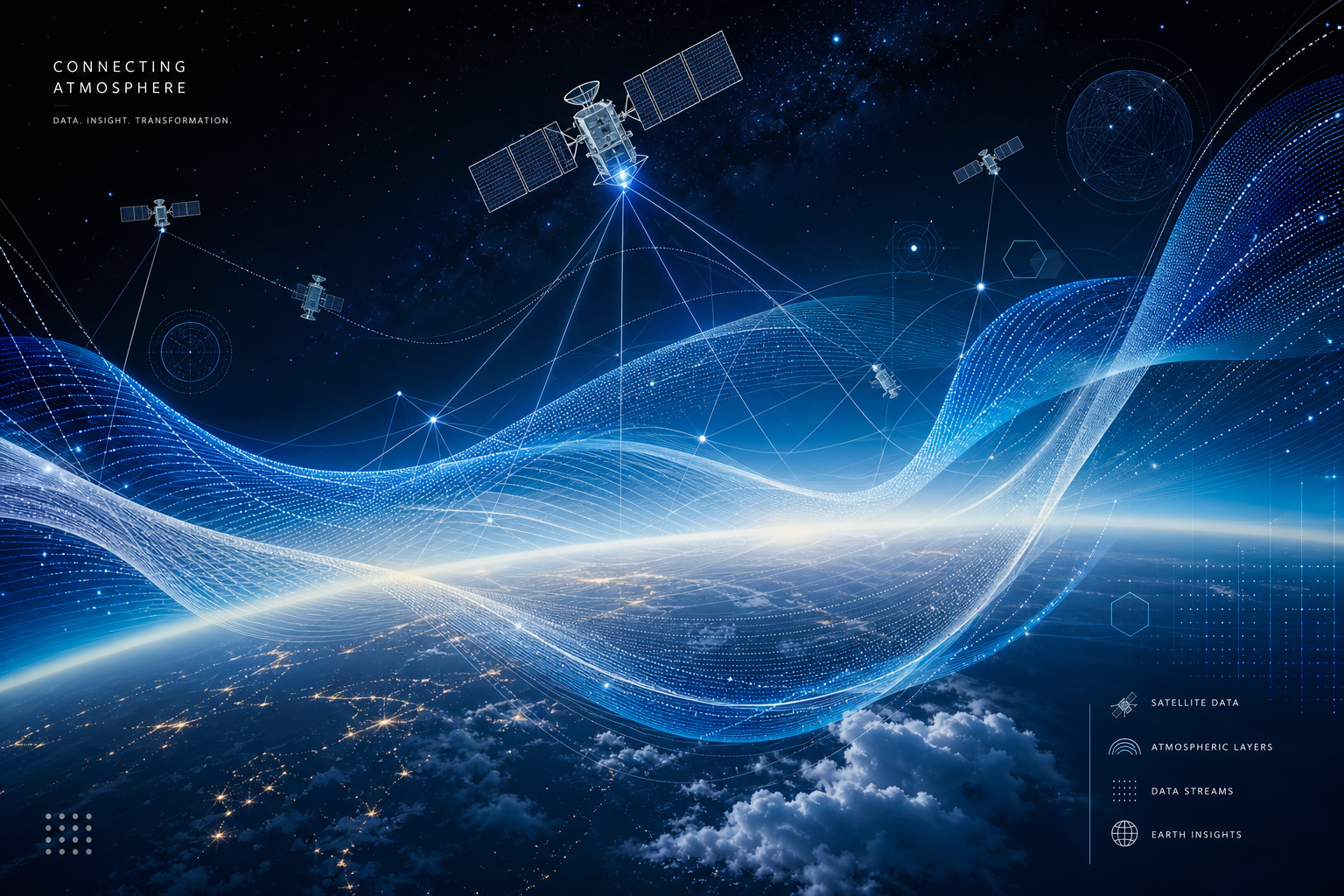
The night sky is becoming increasingly filled with satellites, creating both challenges and opportunities. Researchers have found a clever way to use data from approximately 1,200 Starlink satellites to map Earth's upper atmosphere. While the number of operational satellites can vary, this development is a testament to scientific ingenuity and offers promise for enhancing safety in the crowded realm of space orbit.
Mapping the Unseen
The upper atmosphere, particularly around 500 kilometers above Earth, presents challenges for scientists due to its dynamic nature and the difficulty of direct observation. It's a known scientific understanding that this region poses mysteries. By leveraging the consistent data stream from Starlink satellites, researchers have been able to reconstruct atmospheric density changes at these altitudes. It's akin to unveiling a hidden landscape crucial for understanding weather patterns and satellite trajectories.
This method of atmospheric mapping could potentially refine satellite tracking. With many satellites navigating the same orbital paths, even minor miscalculations can lead to catastrophic collisions. By achieving a more precise understanding of atmospheric conditions, scientists may predict satellite movements more accurately, thereby reducing the risk of collisions.
The Business of Space Safety
The implications of this breakthrough could extend into the commercial sector, offering potential benefits for companies invested in satellite technology, such as SpaceX with its Starlink constellation. While the original source doesn't explicitly discuss commercial outcomes, it's reasonable to infer that improved tracking capabilities might help avoid collisions, ensure the longevity of costly equipment, and maintain a seamless global communications network.
In this sector, where milliseconds impact millions of dollars, the ability to predict and adapt to atmospheric changes in real-time could be transformative. Businesses may optimize satellite operations, reduce downtime, and reassure investors and stakeholders about their technological resilience.
A Personal Reflection on Innovation
Reflecting on this development, it's fascinating to see how human curiosity and technological prowess intersect. We've taken a sky that could be seen as cluttered and turned it into a resource for better understanding our planet. This highlights our ability to adapt and innovate, finding solutions in unexpected places.
However, it also prompts a question about our responsibilities as we advance further into space. How do we balance technological progress with the need to preserve the space environment? It's a delicate balance requiring not just innovation, but foresight and regulation.