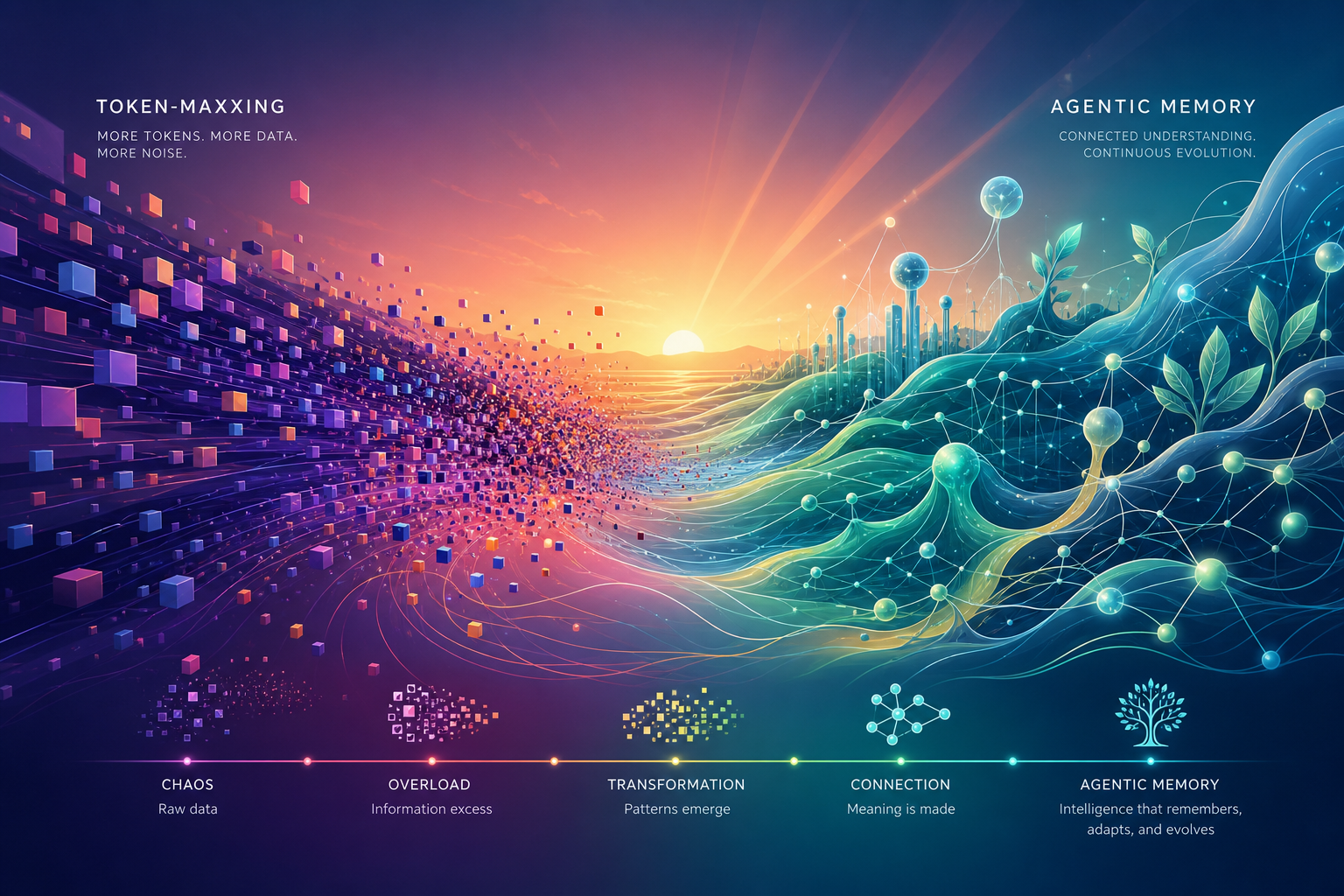
As we stand at the precipice of a new age in artificial intelligence, it's crucial to reflect on how far we've come. The journey from what some have termed "token-maxxing" to agentic memory marks a significant shift in how we understand and develop AI systems. While databases have been around for sixty years, AI agents in their current form, as we understand them today, have been evolving for about 18 months. This stark contrast highlights the infancy of our current journey in AI development, with much more to explore and learn.
From Token-Maxxing to Memory-Driven AI
In early 2026, the AI industry experienced a brief obsession with "token-maxxing," where performance was measured by the volume of tokens consumed by AI systems. This concept, although not widely recognized as a standard term, refers to a period when token consumption became a superficial metric of success. However, it soon became clear that this approach measured activity rather than meaningful outcomes, thus missing the mark on efficiency and effectiveness.
The real lesson from this phase was the realization of the importance of the context window as a scarce resource. The challenge isn't about cramming more data into every AI prompt but rather about discerning what information is truly essential. The solution lies in a structured memory system that persists beyond the immediate context. This is where agentic memory comes into play.
Building a Memory System That Lasts
Agentic memory offers a solution that surpasses the limitations of the context window. It allows AI to retain the outputs of previous sessions, preventing the need to repeat expensive reasoning processes. This is achieved through a persistent, queryable memory system that feeds the model deliberately.
A well-designed agentic memory must do three things:
-
Preserve past outputs: By storing the results of generative models from previous sessions, organizations avoid redundant computations and reduce costs.
-
Implement role-based access control: This ensures that sensitive information is shared appropriately across an enterprise, safeguarding privacy and security.
-
Facilitate semantic search: Unlike traditional databases that rely on exact matches, agentic memory must retrieve information based on meaning, allowing for more intuitive and efficient data retrieval.
These capabilities align with the lessons learned from decades of database development, yet require a fresh approach tailored to the needs of AI.
The New Architecture of AI Interactions
As organizations begin to embrace agentic memory, a new architecture is emerging. This involves pairing a robust memory system with a leaner AI model. The model's role is not to generate brilliant solutions but to serve as an efficient evaluator. When a query is made, the agent performs a semantic search within its memory, ranks potential answers, and determines if the best candidate is sufficient.
If the stored memory provides an adequate response, the system bypasses the costly generative model altogether. However, if the memory falls short, the system escalates to the generative model, produces an original solution, and saves it back into memory for future use.
This approach flips the economic model of AI on its head. Instead of costs growing linearly with usage, the system becomes cheaper and faster over time. Each new solution generated enhances the memory, making future queries more cost-effective.
The Human Touch in Curating Memory Types
A final frontier in this evolution is the categorization of memory types. Just as human memory is not a homogenous entity, agentic memory should be similarly nuanced. Taxonomic memory holds organizational terminology, ensuring consistency in language and meaning. Procedural memory captures task sequences, turning an AI into a reliable colleague by embodying the nuances of organizational processes.
Determining the right taxonomy of memory types is a challenge that lies ahead. It requires careful curation and an understanding of the unique needs of each organization.
This journey from token-maxxing to agentic memory signifies more than a technological shift. It represents a fundamental change in how we perceive and interact with AI. As we continue to build and refine these systems, we are not just creating more efficient AI. We are crafting a new paradigm of digital transformation, one that learns from the past and anticipates the future.
What do you think? How will the evolution of agentic memory shape the future of AI and its integration into our daily lives?